
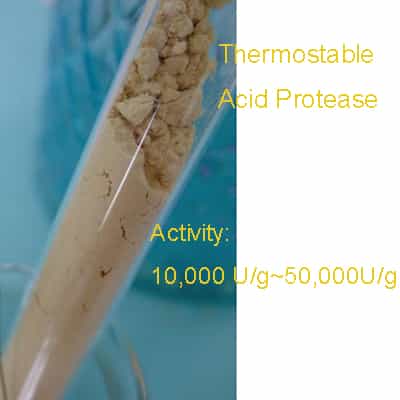
Feed Additive Thermostable Acid Protease
Product Video
Product Introduction
Product Description
Acid proteases, derived from Aspergillus niger strains, are effective in hydrolyzing proteins at low pH and are used in the feed industry as exogenous enzymes in animal feeds, feed additives, and feed compositions, or for processing vegetable proteins.
The low utilization of feed proteins by animals leads to the fermentation of undigested proteins in the hindgut, producing harmful substances such as hydrogen sulfide, ammonia, and cresol. This not only affects the intestinal health of animals, causes diarrhea, and reduces productivity, but also increases environmental pollution from farming. Improving the digestibility of feed protein is an important measure to solve this problem. Adding proteases to animal diets is one of the effective ways to improve the digestibility of animal proteins. Currently, proteases can be broadly classified into three categories based on the optimal pH for their function, namely acidic, neutral and alkaline proteases. However, there are some problems in the practical application of different types of proteases. In general, acidic proteases are less temperature resistant, while neutral and alkaline proteases are slightly more temperature resistant than acidic proteases, but generally less acid-resistant, which greatly limits the application of proteases in feeds. Our feed proteases, which do not require process treatment such as coating, have significantly improved temperature resistance.
Feed enzymes are produced by microbial fermentation and are added to feed to improve digestion and utilization of feed or improve metabolic efficiency in animals. Enzymes that can be added to feed include Protease Mix, Thermostable Phytase, Highly Efficient Phytase, NSP Enzyme, Lipase, Pectinase, Cellulase, α-Amylase, Alpha- Galactosidase, Beta-Glucanase, Glucose Oxidase, Thermostable Acid Protease, Acid Protease, Thermostable Acid Beta-Mannanase, Beta-Mannanase, Xylanase, etc.
About 70% or more of poultry sticky wheat rations worldwide have enzymes added to them, and nearly 90% of poultry feeds in Europe contain enzymes.
Enzyme preparations are divided into three main categories:
Non-starch polysaccharidases
Non-starch polysaccharide enzymes include xylanase, β-glucanase, β-mannanase, cellulase, α-galactosidase, pectinase, etc., which act on the corresponding NSP in the feed. livestock and poultry do not secrete this type of enzyme and must be added exogenously from the feed, which is the main enzyme preparation for feeding.
Phytase
Phytase has a special spatial structure that sequentially separates phosphorus from phytic acid molecules and degrades phytic acid (salt) into inositol and inorganic phosphorus while releasing other nutrients bound to phytic acid (salt).
Endogenous digestive enzymes
Endogenous digestive enzymes are enzymes that can be secreted by the animal’s digestive tract itself, mainly proteases, amylases, and lipases. In some special cases, endogenous enzymes also need to be supplemented by the feed.
Product Feature
- High biosecurity, strong heat resistance, strong stability.
- Supplement the deficiency of endo-protease.
- Destroy the hydration shell of the chyme and expand the interface between the chyme and mucous membrane of the small intestine, to improve nutrient digestibility.
- Degrade the anti-nutritional factors of protein and improve digestibility by 4% for the corn-soybean meal diet.
Product Parameter
Species: Poultry or livestock.
Dosage: 100-200g/t complete feed for young animals; 50-100 g/t complete feed for adult animals.
HS Code: 2309901000.
Usage and Storage:
Keep away from the moisture and avoid storing it in a high-temperature environment. Seal both internal and external packages after use.
12 months from the date of production under proper conditions in a dry well ventilated and cool place.
FAQ
A: No, according to customer needs.
A: The professional QC team will control the quality of the goods during all mass production, or if you wish, you can arrange a third-party inspection service. We will provide bulk samples for evaluation before shipment.
A: The sample is free, but the freight is payable. Please contact us in advance if you need samples. You can prepay shipping charges via PayPal or Western Union, and we will send samples as soon as we receive your shipping charges. Or you can provide your courier (DHL, TNT, etc.) account to us for pickup.
A: We can provide customers with full supervision of the procurement process and deliver the most satisfactory goods to them.
Accept delivery terms: FOB, CFR, CIF, EXW, CIP, DDP, express; Accept payment currencies: US dollars, Euros.
A: Yes, we do. We are a professional company in livestock farm products. We have a professional and strict quality control, we must provide you the best service for your need. Our product service department will keep in touch with customers and reply at any time.
Yes, we accept ordering samples to check quality. And mixing samples is acceptable.
A: For preparing samples, depending on the number of samples and process requirements, our preparation time is 1-7 days. International express delivery time is 3-7 days.
Related products
-
 Animal Feed Additive Products
Feed Additive Lysine
-
 Animal Feed Additive Products
Mono Calcium Phosphate MCP Feed Additive
-
 Animal Feed Additive Products
Tricalcium Phosphate TCP Feed Additive
-
 Animal Feed Additive Products
Feed Additive Protease Mix
-
 Animal Feed Additive Products
Feed Additive NSP Enzyme
-
 Animal Feed Additive Products
Feed Additive Feed Enzyme Lipase
-
 Animal Feed Additive Products
Animal Feed Additive Alpha-Galactosidase
-
 Animal Feed Additive Products
Animal Feed Additive Acid Protease


